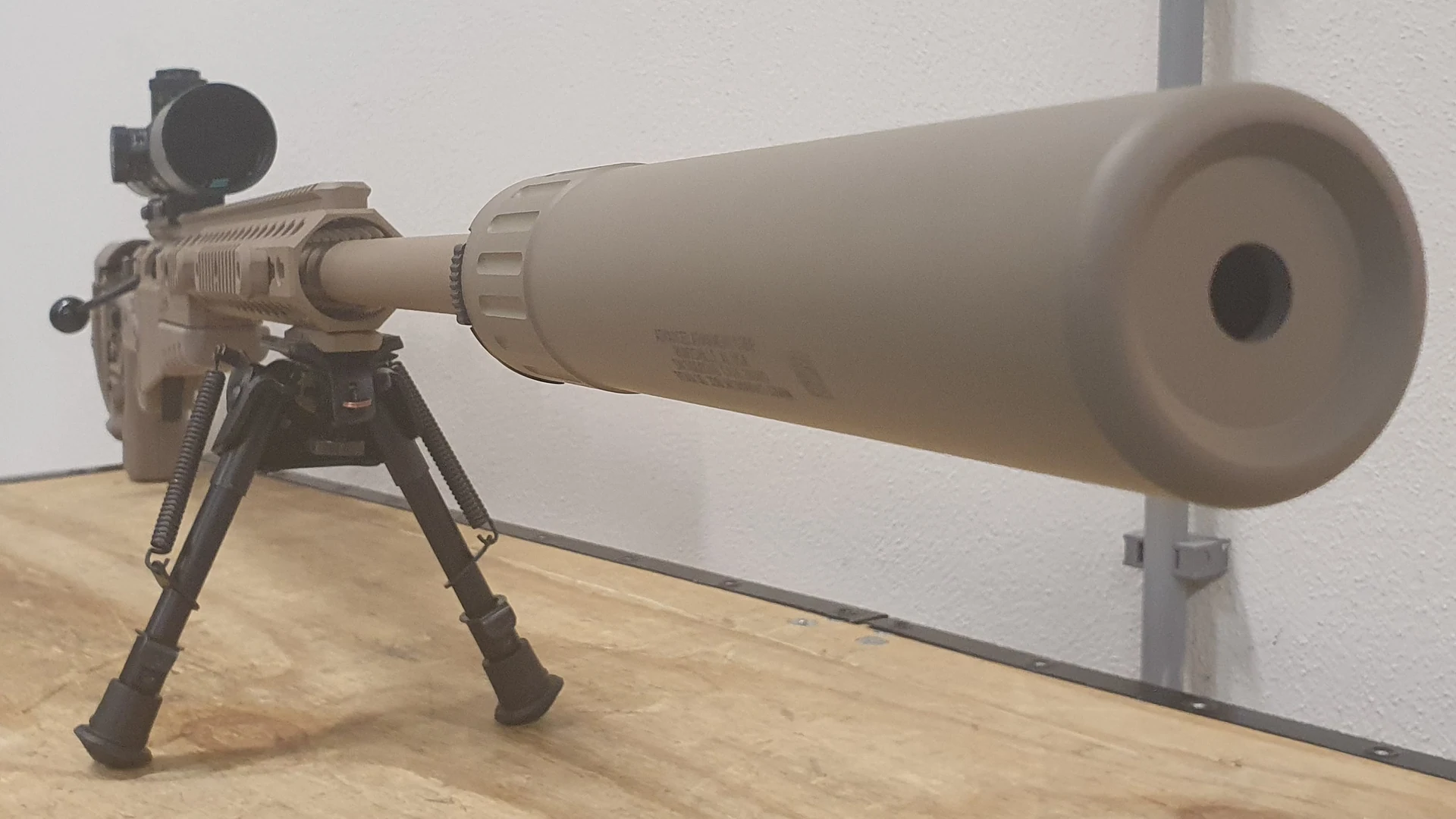
The Department of State has removed firearm silencers, mufflers, and sound suppressors for non-automatic and semi-automatic firearms from the U.S. Munitions List, and the Bureau of Industry and Security picked them up on the Commerce Control List in a companion rule published the same day. Both interim final rules published July 23, 2026 and take effect November 20, 2026. Comments on both close August 24, 2026, which leaves a narrow window for affected registrants to raise operational concerns before the transfer takes hold. Both agencies acted in support of the Executive Order of April 9, 2025, “Reforming Foreign Defense Sales to Improve Speed and Accountability,” which directed a review of Munitions List scope so that the list covers only the most sensitive and sophisticated technologies.
What Moves to Commerce and What Stays on the Munitions List
USML Category I paragraph (e) previously covered silencers, mufflers, and sound suppressors without distinguishing the firearm they attach to. The revised paragraph now reads “Silencers, mufflers, and sound suppressors, specially designed for defense articles described in paragraph (b) or (d) of this category,” which confines State Department jurisdiction to suppressors built for the defense articles those paragraphs describe.
Suppressors for fully automatic firearms stay under State Department control, and the Department explained why in the rule itself. “The Department continues to assess that silencers, mufflers, and sound suppressors specially designed for fully automatic firearms provide a critical military or intelligence advantage,” the interim final rule states.
Everything else moves to two new Commerce entries whose scope turns on the firearms the suppressor can be used with rather than on design intent alone. ECCN 0A501.f covers “Silencers, mufflers, and sound suppressors for use with a commodity controlled by paragraph .a or .b of this entry or ECCNs 0A506 or 0A507,” while ECCN 0A502.f covers those “for exclusive use with a commodity controlled by ECCNs 0A502 or 0A508.”
Neither Rule Addresses Material Already Staged for Destruction
Neither interim final rule contains transition provisions for existing State Department licenses, technical assistance agreements, manufacturing license agreements, or pending applications. The only savings clause in either document covers shipments already en route on July 23, 2026, and those must complete the export no later than August 24, 2026.
Nothing in either rule addresses on-hand inventory, scrap, or reject material sitting in a facility’s destruction queue when the effective date arrives. A suppressor that qualifies as a defense article on November 19 becomes an EAR-controlled commodity on November 20, and the documentation a facility generates when it destroys that item follows whichever regime governs on the date of the disposition rather than the date the item was manufactured. Aerospace and defense generators running scheduled ITAR destruction cycles should treat the effective date as a hard boundary in their scheduling, because material cleared on either side of it produces a different paper trail.
The Two Recordkeeping Regimes Trigger on Different Events
Both regimes require five years of records, and the similarity stops at the retention period. The events that start the clock are not the same, and that difference reaches domestic destruction directly.
ITAR section 122.5(a) requires a registrant to “maintain records concerning the manufacture, acquisition and disposition … of defense articles,” and sets retention at five years. The obligation attaches to the registrant and names disposition explicitly, so destroying a defense article generates a record requirement whether or not that item ever crossed a border.
EAR part 762 attaches to transactions instead of to a registrant. Section 762.1(a) scopes the recordkeeping obligation to exports from the United States, known reexports, transfers, transshipments, and diversions. Section 762.6(a) sets the same five years, running from “the export from the United States of the item involved in the transaction,” a known reexport or transfer, or “any other termination of the transaction.” A purely domestic destruction of scrap that never enters an export transaction sits outside those triggers.
The practical consequence is that documentation which the ITAR compels today becomes discretionary for some material after November 20. Facilities that destroy suppressor scrap domestically have good reason to keep certificates of destruction on the ITAR schedule as a matter of standing practice, since the record proving an item was destroyed rather than diverted is the record that answers an enforcement question years later.
Registration Relief Reaches Only Suppressor-Only Manufacturers
The registration question follows the same logic as the recordkeeping one. ITAR section 122.1(a) is explicit that “A manufacturer who does not engage in exporting must nevertheless register,” and section 122.3(a)(1) sets the first-tier registration fee at $3,000 per year.
A company whose only Munitions List nexus was semi-automatic suppressors can evaluate dropping State Department registration once the transfer takes effect. A facility that manufactures any other defense article remains registered on the same terms as before, and most aerospace and defense waste generators fall into that second group. For those operations the destruction and recordkeeping obligations attached to their other defense articles carry forward unchanged, and that distinction is easy to lose in coverage framing the rule as broad deregulation. Enforcement attention on aerospace facilities has not softened either, as the federal search at GKN Aerospace demonstrated earlier this year.
Steps Before November 20
Four steps carry most of the value in the time remaining. Inventory and classify on-hand suppressors, scrap, and reject material against the revised Category I(e) language, separating anything specially designed for fully automatic firearms, since that material stays on the Munitions List.
Decide whether material already staged for destruction clears before or after November 20, and document the classification basis for that decision either way. Preserve certificates of destruction on the five-year ITAR retention schedule regardless of which regime governs on the disposition date. Facilities that find that the absent transition language creates real operational problems can file comments through August 24, 2026, referencing RIN 1400-AG11 for the State Department rule or RIN 0694-AK35 and docket BIS-2026-0034 for the Commerce rule.
Sources
Source: Federal Register, U.S. Department of State, “USML Category I Firearm Suppressors” (2026-07-23) | Federal Register, Bureau of Industry and Security, “Implementation of EAR Export Controls on Silencers, Mufflers, and Sound Suppressors” (2026-07-23) | eCFR, 22 CFR Part 122 | eCFR, 15 CFR Part 762
Tags